



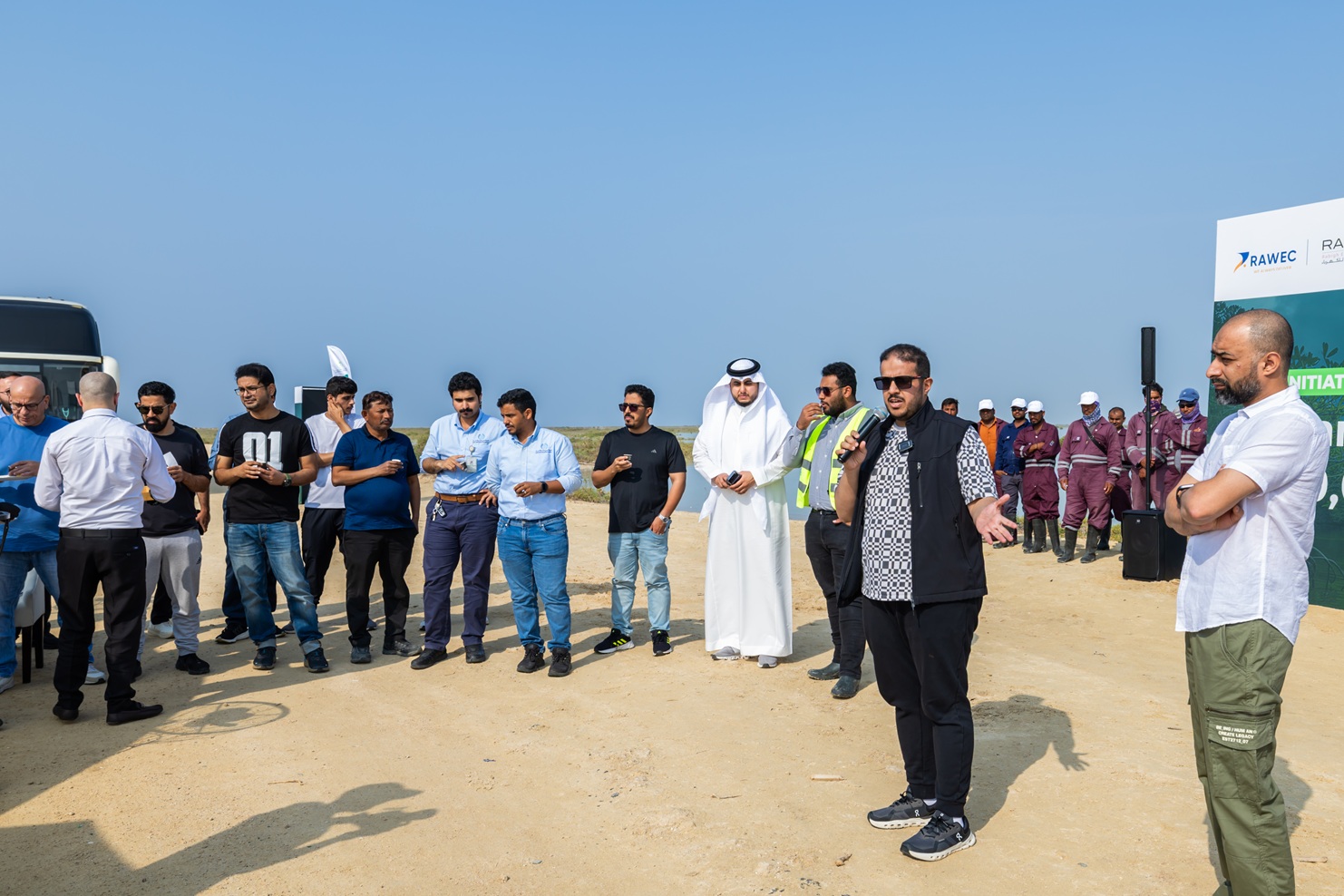
The tide was low, the morning still. Employees from Acwa and its subsidiaries waded into the shallows off the Rabigh coastline in the late days of December 2025. Boots sinking into sediment, trays of Avicennia marina saplings balanced against their hips – not a typical day for Acwa employees. Each pencil-thin seedling, roughly 20 to 30 centimeters tall, had been carefully cultivated and transported to the site in batches.
The volunteers – now fully prepped – pressed them into the intertidal mud one by one, following a planting grid mapped from topography and tidal range studies completed months earlier. No staged handshakes or media, just people from engineering, operations, finance, and corporate functions dedicating their time to doing something unusual for a global utility company: putting living things into the ground with their own hands.
The Accountability Gap
The scene at Rabigh marked a turning point – a symbolic expression of a strategy that had been quietly making an impact over several years. Acwa’s operational presence along Saudi Arabia’s West Coast is vast. Operating at that scale, in those ecosystems, demands a relationship with the coastline that is as much about sustainability, responsibility, and respect for the natural world as it is commercial output.
Dr. Hisham Alghamdi, who manages the CSR programs at Acwa, traces the shift to a hard realization. “A few years ago, Acwa announced the establishment of the Shuaibah Nursery to support the Saudi Green Initiative. While it was a noble start – distributing approximately 400,000 seedlings since 2023 – our tracking revealed a challenge. Once those seedlings were handed over to municipalities and locals, we lost visibility into them.
“We couldn’t verify their survival or their actual impact.” For Acwa, this mattered because without monitoring survival, or measuring carbon sequestration, or replacing seedlings that failed to survive, it simply produced a set of numbers rather than meaningful outcomes. “From our perspective,” Dr. Alghamdi says, “this was an unsustainable model that didn’t make a tangible contribution to Acwa’s strategic Net Zero journey.”
What replaced it is a precision reforestation framework built around a seven-stage project flow: site evaluation, mobilization, transportation, plantation, tree logging, a volunteer initiative, then survival monitoring and compensation. The Rabigh mangrove project is the first full-scale deployment of this model.
Engineering an Ecosystem
The site lies within a protected coastal zone covering more than 2,000,000 m². Permissions were granted by the National Center for Vegetation Cover (NCVC) in September 2025, followed by a Border Guard permit days later. Within weeks, soil and seawater samples were collected for laboratory analysis, and topographic surveys confirmed that the tidal range was sufficient to support the target species.
Sixty thousand Grey Mangrove saplings – every one of them Avicennia marina – were cultivated and transported to the site in multiple batches, reaching 100% delivery by November. Planting of the first batches began thereafter, and by the end of December, a total of 54,253 saplings had been planted: 90% completion. A photo-capture and tree-logging process that is essential for the digital dashboard tracking every individual plant.
The partner working with Acwa to execute this vast and complex project is Net Zero (Alheyad Alsufri Environmental Service Co.), a Saudi company whose satellite imaging and reporting platform has scaled from the Kingdom to Brazil, Egypt, and Africa. Dr. Alghamdi is direct about why the partnership matters: “They plant, monitor, calculate annual offsets, and replace lost trees, ensuring our environmental contributions are verified and permanent.” Then there is a ‘compensation phase’ – replacing saplings that don’t survive. All failed trees are replaced, and every gap is accounted for.
Why Mangroves, Why Here
Many people ask why mangroves and why you are planting them here. Eng. Abdulrahman Alsum, CSR and Sustainability Director at Acwa, frames the logic in both commercial and ecological terms. “As a company leading the way in desalination – particularly along the West Coast of Saudi Arabia – we recognize a deep responsibility toward the ecosystems where we operate. Mangroves are exceptional in this regard; they sequester carbon at higher rates than other ecosystems, create vital habitats for marine life, and provide essential protection for our coastlines.”
Acwa avoided 2.82 million tons of CO₂ equivalent in 2024 through its renewable portfolio. A 12% reduction in emissions intensity relative to the 2020 baseline is on record, with a 50% reduction in greenhouse gas intensity targeted by 2030. Mangrove restoration adds a biological sequestration layer that industrial decarbonization alone cannot deliver.
Alsum also sees reforestation as a potential business avenue: “By aligning with the Saudi Green Initiative, we are proud to showcase a model that connects government, the private sector, and the community. This project highlights a successful Saudi partnership with a private company that has scaled from the Kingdom to the world.
After the Volunteers Leave
What happens next is what separates this initiative from a one-off activation. Satellite imaging will track canopy development, and saplings that haven’t survived will be replaced within the compensation window. There’s an idea gaining traction internally – forming a recurring employee task group that would return to the Rabigh site periodically, check plant health, observe growth patterns, and feed field data back into Net Zero’s reporting system.
Now, nature takes its course. The tide will rise and fall over those 54,253 saplings. The volunteers who planted them will return to turbines, control rooms, desalination membranes, and project spreadsheets. What stays behind in the sediment is a different category of infrastructure – one that grows, one that is measured, and one that a company has committed to maintain long after the planting day ends.