



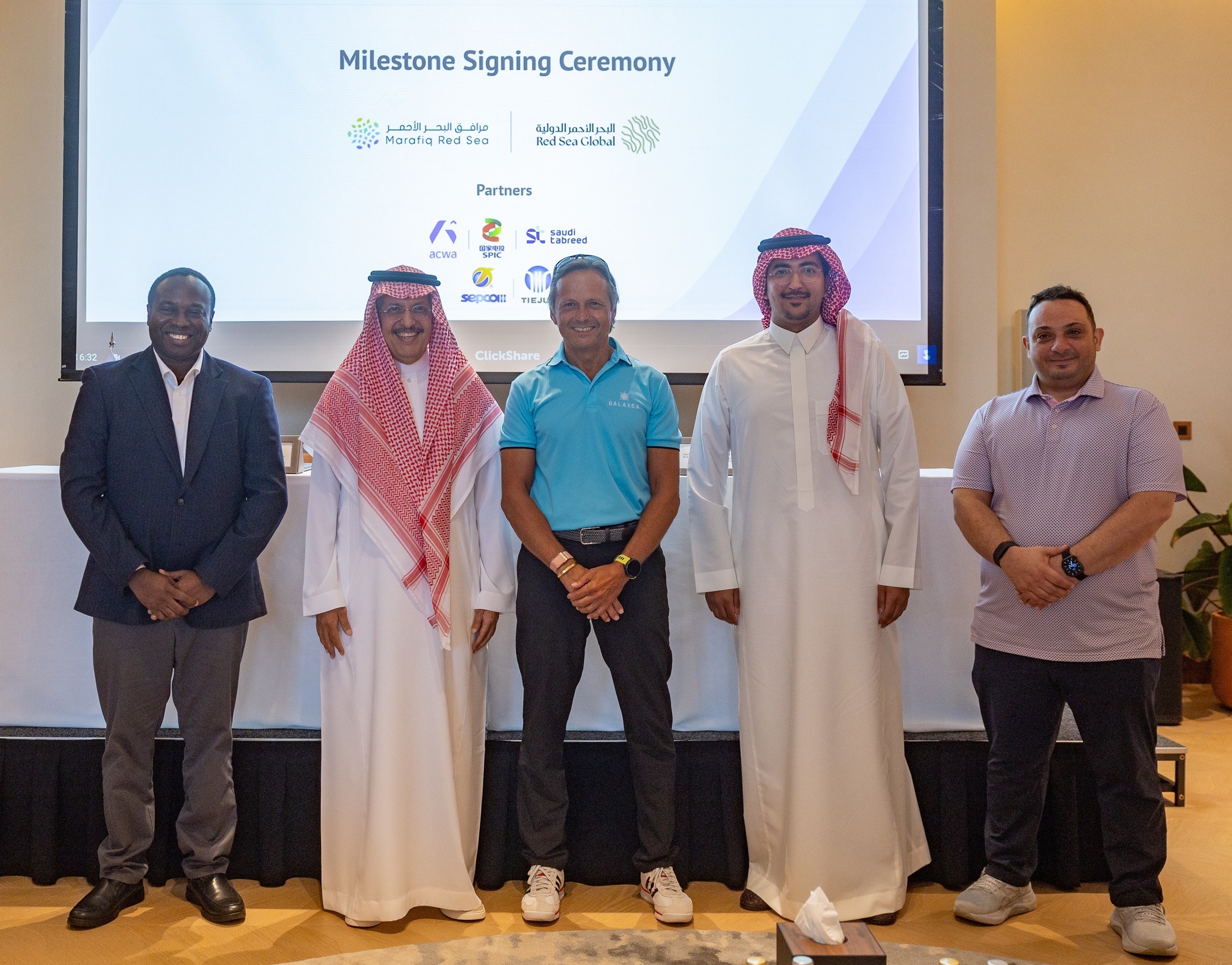
Saudi-listed Acwa, the world’s largest private water desalination company, a leader in the energy transition, and a first mover into green hydrogen at scale, has reached Project Commercial Operation Date (PCOD) for The Red Sea destination, with the certificate signed by Marafiq Red Sea for Energy Company (“Marafiq”) – the project company formed by Acwa with SPIC Huanghe Hydropower and Saudi Tabreed – and by The Red Sea Utilities Company, a subsidiary of Red Sea Global.
The signing confirms that the utility systems are in commercial service. This marks the first time a giga-project in the Kingdom has successfully brought its entire utility systems into commercial operation powered solely by renewable energy, with no reliance on or support from the national grid.
Mohammad Abunayyan, Founder and Chairman of Acwa, said: “The Red Sea project embodies the ambition of Saudi Vision 2030 and the vision of His Royal Highness Prince Mohammed bin Salman bin Abdulaziz Al Saud, Crown Prince and Prime Minister, to deliver pioneering projects that redefine modern infrastructure and reinforce the Kingdom’s position as a global leader. As the world’s largest integrated off-grid utilities system, and the first of its kind at this scale, the project sets a new global benchmark for sustainable development.
He added: “By bringing renewable energy, water, and environmental services together within one integrated platform, the project demonstrates that infrastructure at this scale can enable economic growth while protecting natural resources and the environment for future generations. It also provides a world-leading model for delivering utilities as one cohesive system, enhancing efficiency, resilience, and long-term reliability.”
Mohammad Abunayyan concluded: “This achievement demonstrates the power of public-private partnership to translate the Kingdom’s ambitions into reality by combining clear vision with private-sector expertise, innovation and execution capabilities. Our 25-year concession reflects the long-term nature of this partnership, with Acwa and its partners developing, operating and maintaining the utilities that will serve the destination for the life of the concession. At Acwa, we are proud to have contributed capabilities developed in Saudi Arabia to a project that demonstrates what the Kingdom can achieve and provides a model with relevance for future developments at home and around the world.”
John Pagano, Group CEO at Red Sea Global, said: “This milestone brings our vision for a new model of regenerative tourism to life at full scale. By operating without a connection to the national grid and powering the destination entirely through renewable energy, we are demonstrating how sustainable infrastructure can support tourism that gives back to the natural environment and communities on which it depends.”
The Acwa-led consortium, including SPIC Huanghe Hydropower and Saudi Tabreed, provides renewable power, potable water, wastewater treatment, district cooling, and waste management. Financial close had previously been announced in February 2022, with c. USD 1.33 billion senior debt facilities (with a total investment of c. US$1.84 billion), funded by Saudi and international banks – a landmark in bankability for first-of-a-kind off-grid infrastructure. The utility system was engineered and constructed by SEPCO III (the Shandong Tiejun consortium) as EPC contractor and is operated and maintained by Acwa Operations under a long-term operation and maintenance agreement aligned with the full 25-year concession period.
Generation comes from a 340 MWac solar photovoltaic plant working alongside a 1,227 MWh battery energy storage system, the largest off-grid battery installation built anywhere. The pairing supplies the destination through the night and has been sized to meet initial energy demand. The integrated utilities platform has been structured to scale alongside the destination, allowing additional capacity to be developed as future phases come online. The generating system delivers up to 760,000 MWh of clean energy a year, avoiding around 600,000 tons of carbon dioxide over the same period.
The scope of the project also covers the construction of three seawater reverse osmosis (SWRO) plants, a waste management center and a sewage treatment plant (STP) that will allow 16,000 m3/day of waste to be treated in a way that enhances the environment by creating new wetland habitats and supplementing irrigation water for the RSG landscape nursery and Shura Links golf course. Additionally, district cooling totaling 32,500 refrigeration tons (RT) now serves the hotels and the airport.
The construction phase was delivered with an LTI (lost time injury)-free milestone achieved across 30 million safe working hours – a safety record of distinction for a program of its scale and complexity that has been executed in a remote coastal environment.
From the outset, the project was given an environmental mandate matched by few developments anywhere: to deliver an entire destination’s utilities while protecting one of the world’s most pristine marine environments. All utility services underwent rigorous Environmental and Social Impact Assessment (ESIA) processes and received the requisite permits from the National Center for Environmental Compliance (NCEC). In addition, these services remain subject to Marafiq continuous environmental compliance and monitoring following their environmental commitments throughout operations, ensuring ongoing compliance and stewardship of the surrounding marine and terrestrial ecosystems.
Local content ran through the construction phase and continues into operations. Equipment, materials, and services were procured from Saudi suppliers wherever the specification allowed, and Saudi engineers and technicians worked across the solar, storage, desalination and cooling packages alongside the EPC contractor. Over the 25 years ahead, the operation and maintenance workforce is being built inside the Kingdom, with spares and consumables sourced from local suppliers that meet the required standard.
As an off-grid system powered entirely by renewables, sustainability is an integral part of the project’s design and operation: renewables, paired with large-scale storage, electric vehicles that serve the destination’s logistics on land and sea, nature-based treatment processes, and responsible waste management and resource recovery.
The project also aligns with Saudi Vision 2030, which opened state-owned assets to private developers and accelerated the deployment of renewable energy across the Kingdom. The Red Sea destination exemplifies this approach, with a Saudi-listed developer and its partners managing an entire destination’s utilities through renewable generation – power that is clean at source and water drawn and returned without harming reef systems. These obligations are interconnected and could conflict unless the services are designed cohesively, which is why all five sit inside one concession.
Across the 25 years, the concession keeps skilled operations and maintenance work in the Kingdom, builds a Saudi supplier base around the destination’s regenerative tourism economy, and keeps Acwa alongside its customer for the life of the asset rather than handing over the keys at commissioning.