



Renovation in the GCC is being redefined by necessity as much as by design ambition. Buildings are no longer taken out of operation for refurbishment in the way they once were. Instead, they are upgraded while in use, often under tight operational constraints that leave little room for disruption. This reality is reshaping how value is created in the built environment. What matters is no longer limited to visible renewal, but to how reliably a building continues to perform through successive cycles of intervention.
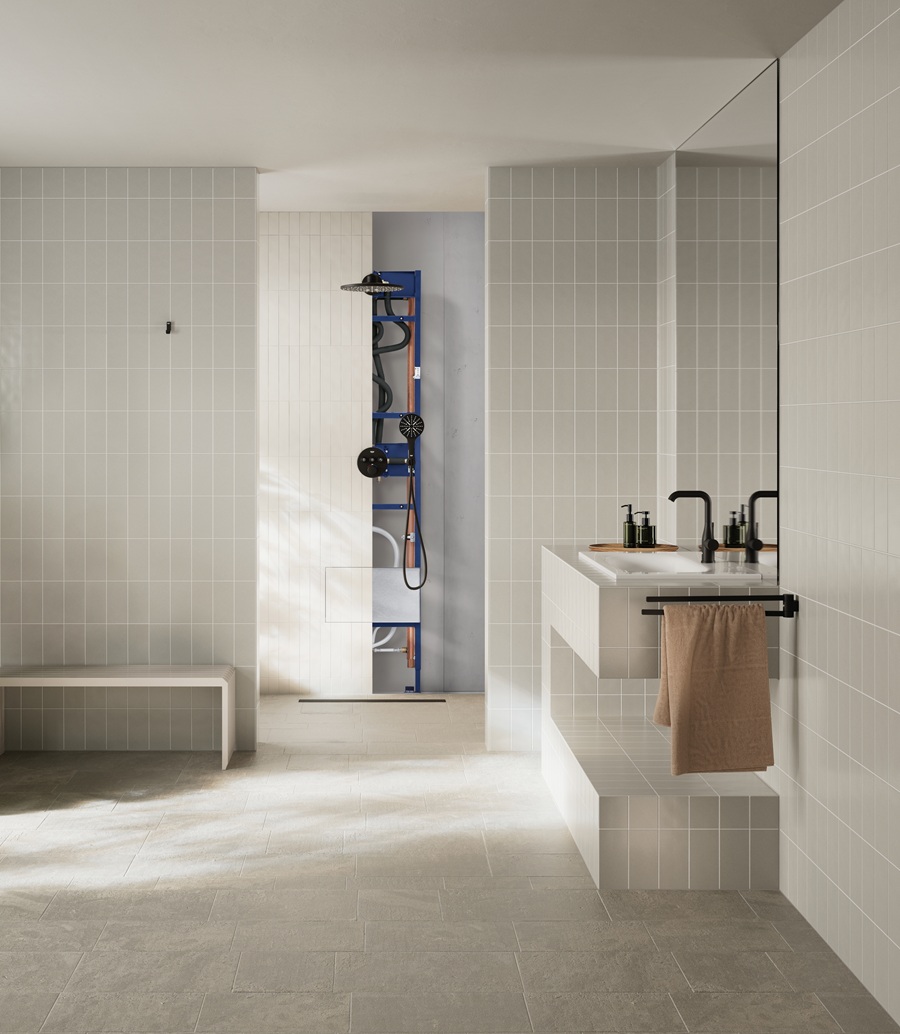
Nowhere is this more evident than in bathroom infrastructure, where the most important systems are rarely visible once a project is complete. Concealed cisterns and behind-the-wall installation systems form the functional core of this environment. They manage water storage, flushing performance, and service access within a sealed architectural layer designed to remain in place long after surface finishes are replaced. The significance of these systems is not aesthetic. It is structural. They determine whether a bathroom can be upgraded without being dismantled, and whether performance can be improved without disturbing the infrastructure that supports it.
Within GROHE’s approach, these elements are part of a wider water system architecture rather than isolated components. Concealed cisterns, pipework interfaces, and flow regulation technologies are designed to work as a connected system, ensuring that water delivery, control, and usage remain consistent and efficient across the lifecycle of the installation. In practice, this changes the nature of renovation itself. With modern concealed installation systems, visible elements such as flush plates, ceramics, and fittings can be replaced independently of the core installation behind the wall. The infrastructure remains intact, while the space evolves around it.
GROHE’s concealed cistern systems are developed around this principle of separation. The system is engineered as a stable backbone within a broader water system, enabling repeated surface-level upgrades without intervention in the structural installation. In dense urban environments and continuously operating assets, this distinction becomes critical. Renovation, in this sense, moves away from wholesale replacement. It becomes a more selective process, focused on extending the life of what already performs well, while upgrading only what needs to change.
This is particularly relevant in the GCC, where hospitality and residential assets operate under continuous pressure to refresh interiors without interrupting occupancy. With more than 700 hotel projects currently in the Middle East development pipeline, according to industry data, refurbishment is not an occasional activity but part of the operational rhythm of the sector. At the same time, residential expansion across the region continues to accelerate, reinforcing the need for systems that can adapt over time rather than be replaced entirely.
Against this backdrop, GROHE concealed systems function less as individual products and more as infrastructure logic within a wider water system. They allow bathrooms to evolve in layers, maintaining stability behind the wall while enabling visible renewal at the surface. Once this structural foundation is established, attention shifts to how water behaves within the system itself.
Water flow is increasingly managed as part of an integrated water system, where delivery, control, and consumption are engineered together rather than treated separately. In GROHE systems, flow regulation technologies are designed in line with European benchmarks for sanitary fittings, including EN 817 Class A for faucets and EN 1112 Class A for showers*. These standards define baseline flow ranges and provide a reference point for system calibration.
What emerges is not a narrative of reduction, but of controlled performance within a connected system. Water is delivered through engineered parameters that balance user experience with regulated flow, ensuring consistency across different usage conditions. In the GCC, where water scarcity is a long-term structural condition rather than a temporary constraint, this level of system-level control carries particular weight. Buildings are expected to perform efficiently from the moment they are occupied, across hospitality, residential, and mixed-use developments alike.
Seen in this context, renovation is no longer defined by the extent of physical change. It is defined by the intelligence of what is retained, and how effectively systems are upgraded without unnecessary reconstruction. Concealed cisterns and behind-the-wall technologies sit at the centre of this shift. They make it possible for buildings to evolve without repeated structural intervention, extending the operational life of bathroom systems while enabling continuous improvement over time.
The most significant transformation in renovation today is therefore not visible. It is embedded in the infrastructure that remains hidden behind the wall, where performance is determined long before the user enters the space.
By: Stefan Schmied, Leader IMEA, LIXIL International