



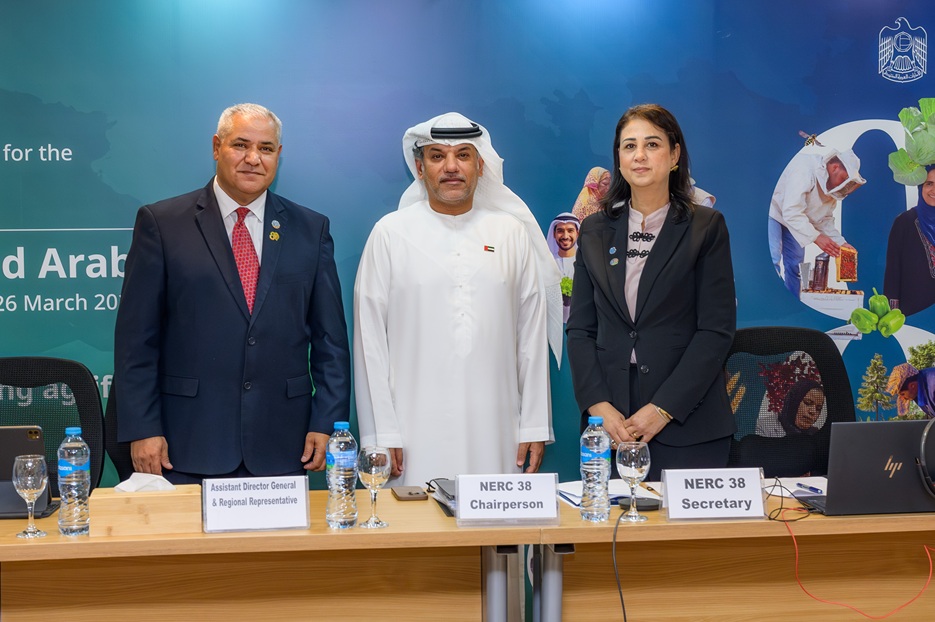
The United Arab Emirates will chair the 38th Session of the Food and Agriculture Organization of the United Nations (FAO) Regional Conference for the Near East (NERC38), hosting the highly anticipated Ministerial Meeting on 21st April in Al Ain. This prominent regional event gains exceptional momentum as it is held in conjunction with the second edition of the Emirates Agriculture Conference and Exhibition, underscoring the UAE’s pioneering role in leading regional efforts towards sustainable agricultural and food systems.
This announcement came on the sidelines of the Senior Officers’ Preparatory Meeting, which commenced today. This meeting represents a fundamental phase laying the technical and policy foundations, discussing existing challenges to formulate recommendations to be adopted during the Ministerial Meeting in the UAE. Held under the theme ‘Innovating for Transforming Agrifood Systems’ the Conference provides a platform for members to coordinate shared priorities and enhance regional cooperation for the next biennium.
The UAE Chairs the Preparatory Meeting
H.E. Mohammed Saeed Al Nuaimi, Undersecretary of the Ministry of Climate Change and Environment, chaired the Senior Officers’ Preparatory Meeting, which was also attended by more than 200 representatives from various countries across the Near East and North Africa.
The Senior Officers’ Meeting serves as a key preparatory phase for the upcoming Ministerial Meeting, providing a strategic platform to discuss challenges, identify regional priorities, and formulate actionable recommendations. Discussions focused on critical areas, including strengthening supply chains, diversifying food sources, improving logistics, and leveraging innovative solutions. The outcomes of this meeting will help guide the upcoming ministerial decisions in Al Ain, strengthen collective action, and support the transition towards sustainable agricultural and food systems that bolster regional food security.
HE Al Nuaimi said: “We meet today at a time of significant transition that requires exceptional action to confront the unprecedented challenges overshadowing our region and its food supply chains. These, in turn, exacerbate the climate, water scarcity, and land shortage issues facing our agricultural systems. The current circumstances impose additional pressures that demand a swift and coordinated response. We highly commend the central role of the FAO in unifying regional efforts to safeguard our food security ecosystem. Guided by the vision of its wise leadership, the United Arab Emirates reaffirms its steadfast commitment to advancing the sustainability of agricultural systems. The UAE will continue to serve as an innovative and pioneering model in leveraging advanced technology and innovation to empower its agricultural sector and overcome obstacles.”
His Excellency added: “Through our Presidency of this Regional Conference, we aspire to lead efforts in driving innovative solutions and deepening cooperation with the Food and Agriculture Organization (FAO) and all countries in the region that face similar challenges. We strongly believe that joint action and knowledge exchange are the only pathways to building resilient and inclusive agricultural systems that ensure food security and fulfill our peoples’ aspirations for a more sustainable future. Moreover, the sustainability of these systems equips us with the necessary agility to navigate the various shifts facing the region, positioning sustainable food security as a fundamental pillar of stability and growth.”
In his opening remarks, Abdulhakim Elwaer, FAO Assistant Director-General and Regional Representative for the Near East and North Africa, underscored the urgency of coordinated action to strengthen the resilience of agrifood systems in the region amid interconnected pressures including climate change, water scarcity, economic volatility and conflict.
“The Near East and North Africa region stands at a critical turning point, where converging crises are placing unprecedented strain on agrifood systems,” he stated.
“Escalating climate shocks, acute water scarcity, geopolitical tensions, and economic instability are not only disrupting supply chains but also undermining national food security and the livelihoods of millions. Urgent, coordinated political action is no longer optional — it is imperative.
“The challenges before us are significant, but so too is our collective capacity to address them,” Elwaer added.
“Together, we are building agrifood systems that deliver for people, for communities and for the future”.
Escalating pressures on food security and natural resources
Across the region, food insecurity remains a major concern. FAO’s Regional Overview of Food Security and Nutrition 2025 shows that in 2024 nearly 77.5 million people — 15.8 percent of the region’s population — experienced hunger, while four in ten faced moderate or severe food insecurity. Millions across the Near East and North Africa continue to face acute food insecurity, and many more are unable to afford a healthy diet, reflecting persistent challenges across the region. Many countries in the region rely heavily on food imports, increasing their exposure to global market volatility and price fluctuations. At the same time, natural resource constraints further intensify the challenge. The Near East and North Africa region remains the most water-scarce region in the world, with agriculture accounting for around 85 percent of freshwater withdrawals, according to FAO’s Regional Initiative on Water Scarcity. Climate variability, drought, land degradation and desertification continue to threaten productivity and rural livelihoods. At the same time, inefficiencies within agrifood systems, particularly food loss and waste, remain significant. Globally, up to one-third of food produced is lost or wasted, representing lost resources and missed opportunities to improve food availability and system efficiency.
Advancing solutions through cooperation and innovation
Despite these challenges, countries across the region are advancing efforts to improve water management, promote climate-resilient agriculture and restore degraded ecosystems. Innovation and digital technologies are opening new opportunities to modernise agrifood systems, enhance productivity and support more informed decision-making.
Ensuring that agrifood systems transformation is inclusive remains essential. Women and youth are not only key actors but central drivers of agrifood systems, yet they continue to face barriers in accessing resources, finance, technology and markets.
The Senior Officers’ Meeting provides a key platform for Members to review progress, exchange knowledge and shape regional priorities. Its outcomes will inform the Ministerial Segment and contribute to coordinated regional action.
FAO reaffirmed its commitment to supporting members through its Revised Strategic Framework (2021-2030), promoting agrifood systems that are more efficient, inclusive, resilient and sustainable.